


Search engine optimization Zurich: The method behind #1 ranking.
No guessing. A record.
Search engine optimization is not a gut feeling or a secret knowledge; it is a comprehensible process consisting of three components: a technically flawless foundation, content that precisely meets the search intent, and verifiable authority. On this page, we explain how we apply this process to companies in Zurich — step by step, using the metrics you are welcome to measure us on.


As featured in


What search engine optimization means in 2026
Search engine optimization (SEO) refers to all measures that ensure a website appears as high as possible in the unpaid search results for commercially relevant queries. It encompasses three areas of work: the technical optimization of the website, the content alignment with the target audience’s search intent, and the building of authority through links and mentions outside the own domain. Unlike paid search engine advertising (SEA), there are no click costs — the investment flows into the substance of the website itself.
«In Swiss language usage, »SEO optimization,« »Google optimization,« and »search engine optimization« mean the same thing. We use the full term on this page because it is more precise: Optimization is not done »for Google,” but for the question that a person asks—today just as in the classic search engine, as well as in Google’s AI mode, Bing, or ChatGPT.
Since 2025, a fourth component has been added that is missing from older definitions: Machine-readable citation. Generative systems do not read content to rank it; they use it to formulate a response. Those who want to be cited need clear statements, verifiable figures, and a clearly identifiable authorship. How we implement this can be found on our page on Generative Engine Optimization.


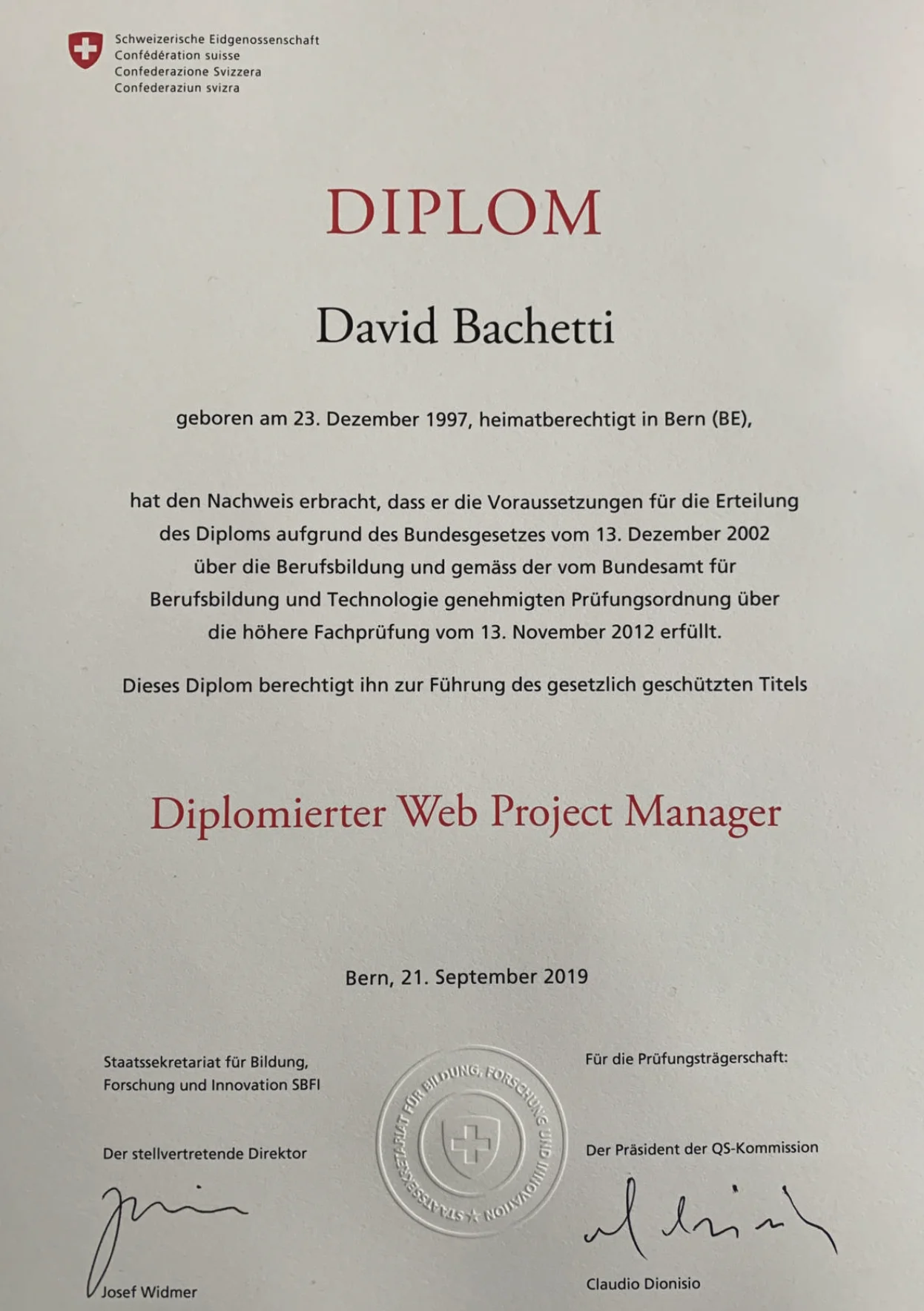
State-recognized expertise: Federal diploma & FH-certified



Who is working on your project in Zurich
You should know who sets your keyword strategy, who handles the technology, and who writes your texts. At us, each discipline has a person with a name — and that same person remains with your mandate from the initial meeting to reporting.
- Strategy, keyword map and technology: David Bachetti, founder and SEO strategist. Web Project Manager with Swiss Federal Diploma (Advanced Federal Professional Examination), CAS Advanced Digital Marketing from the ZHAW School of Management and Law, certified Google Partner since 2018.
- Editorial: Carina Rieger, expert texts based on briefing — no machine-generated content without a professional review.
- Development and implementation: Victor Bravim, technical interventions directly in the system, without going through a third-party agency.
- Motion picture and image production: Senol Tastan, original footage from your business instead of stock images.
The agency AGENTUR GmbH was founded in the canton of Zurich and is a member of the Zurich Chamber of Commerce. If you would like to know who else is working on your project, you can find it here. The team behind the SEO agency Zurich on a separate page — including Diplomas, publications and references of David Bachetti for verification.



The four pillars of search engine optimization
Section 1: Technical foundation
The technology does not determine whether you rank well — it determines whether you can rank at all. We check and fix in this order:
Index hygiene: Which URLs are included in the index, and which are not? Parameter URLs, pagination, tag archives, and test environments clutter the index and dilute the relevancy signals.
Crawling ability & crawl budget: robots.txt, XML sitemaps, internal link depth. Any page that is more than three clicks away from the homepage is less likely to be visited and is rated lower.
Canonicals & Cannibalization: Two pages that target the same keyword compete against each other. Google then chooses one — rarely the one you meant.
Core Web Vitals Largest Contentful Paint, Interaction to Next Paint, Cumulative Layout Shift. Measured on mobile devices in Swiss mobile networks, not in the office Wi-Fi.
Structured data Schema.org labeling, so that search engines and language models recognize entities instead of just reading text.
From practice: At a Zurich-based service provider, 60 of % all indexed URLs were in archive and tag pages with no independent use. After the cleanup, the crawl frequency of the money-related pages increased significantly — without a single new line of text.
Column 2: Content based on search intent
The most common mistake in search engine optimization is not having too much text, but having the wrong text in the wrong place. We assign each search term to one of four intents and derive the page format from this:
Transactional («badsanierung zürich offer») → Performance page with price framework, references and a contact link above the fold line.
Commercially researching («best sanitary company zürich») → Comparison and selection page with verifiable criteria.
Informative («How long does a bathroom renovation take») → A guide that fully answers the question and only then leads to the service.
Navigational (Brand name) → Home page, contact information, company profile.
This results in the keyword map: a table in which each relevant search term is assigned to exactly one URL. It is also the most effective means against cannibalization — and the basis for every content brief we provide to our editorial team.
Column 3: Authority and Evidence
Technology and content contribute to the evaluation. The ranking determines how credible your domain is compared to the competition. Authority in Switzerland is primarily generated through four channels:
Professional media and association publications — a contribution in a trade publication weighs more than fifty listings.
Collect unlinked mentions — Companies are often mentioned without being linked to. Retargeting these mentions into links is the most convenient link source ever.
Local and industry-specific citations with consistent NAP data (name, address, phone).
Own data and studies — the only link type that reproduces itself automatically.
What we don’t do: purchased link packages, PBN networks, comment or forum links. These methods are short-lived and cost rankings in the long run.
Column 4 (new since 2025): Machine citation
Google answers a growing portion of queries directly in the results page or in the AI mode. For your website, this means that your content is read without being visited. To make your brand appear in this response, you need different textual features than for traditional search:
A clear, clear-cut key statement per section — no tension arc that only provides the answer in the last sentence.
Concrete numbers, timeframes, and price ranges instead of «tailor-made solutions».
A name-listed, verifiable authorship.
Consistent information across all channels — website, Google Business Profile, directories, LinkedIn. Conflicting information undermines trust in the knowledge graph.
Why impressions deceive in search engine optimization
In August 2026, we analyzed 344,321 impressions and 1,000 search queries for our own domain. The result has changed the way we build reporting for our clients — and we’re not holding back because it’s relevant for every website operator in Zurich.
For the search query «agence seo,» our domain ranked in the 1.04th position for over twelve months—with 1’349 impressions and zero clicks. Among real users, the click rate at position 1 is between 25 and 35 percent. Zero clicks at position 1 is not a statistical coincidence, but a testament to the fact that these impressions do not come from humans.
There are two causes behind this, and they require completely different responses:
Queries from tracking tools. The SEO space is queried daily by hundreds of programs. These queries generate impressions, but never clicks. A characteristic feature: extreme desktop dominance — 79 percent for us, even though over 60 percent of searches are actually conducted on mobile devices.
Requests from the Google AI mode. 160 of the 1,000 requests were formulated sentences with seven words or more (’which seo agency in zürich is recommended?«). These requests reached an average position of 8.15; 65 of them were in positions 1 to 5 — and generated zero clicks. That’s not a flaw; it’s how the system works: the AI reads the source and answers the question itself.
What we can learn from this for our customers: Impressions and click rates are no longer reliable metrics on consulting-intensive websites. Instead, we measure clicks on money-seeking keywords, position on money-seeking keywords, brand search volume, and the number of qualified inquiries. And we no longer assess the demand for a search term solely through analytics tools but through the click price: A commercial search term with a high indicated volume and a click price of CHF 0.00 usually has no real searchers behind it.
Why we do not report impressions as success
Federal Dipl. Web Project Manager · ZHAW CAS Advanced Digital Marketing · 50+ SEO Projects · Google Partner · Member of the Zurich Chamber of Commerce
«We analyzed twelve months of our own Search Console data and found a search query that ranked at an average position of 1.04, collected 1,349 impressions — and generated zero clicks. In real users, that would have been a 25 to 35 percent click rate. Anyone who sells such impressions as visibility success is selling a measurement artifact. That’s why we report our customers on clicks on search terms and qualified queries — and place the impressions next to them, not above them.’





Why search engine optimization in Zurich follows its own rules
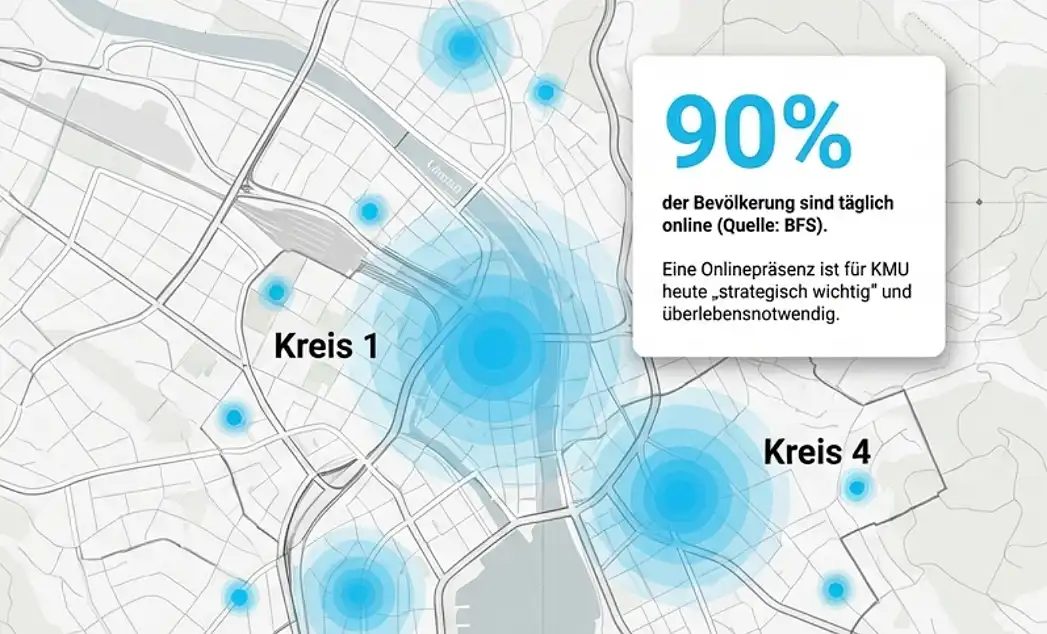
The canton of Zurich is Switzerland’s densest market for services. For many search terms, local businesses compete not only with each other, but also with national brokerage portals, comparison platforms, and directories that operate with much larger budgets. Therefore, four factors are disproportionately decisive:
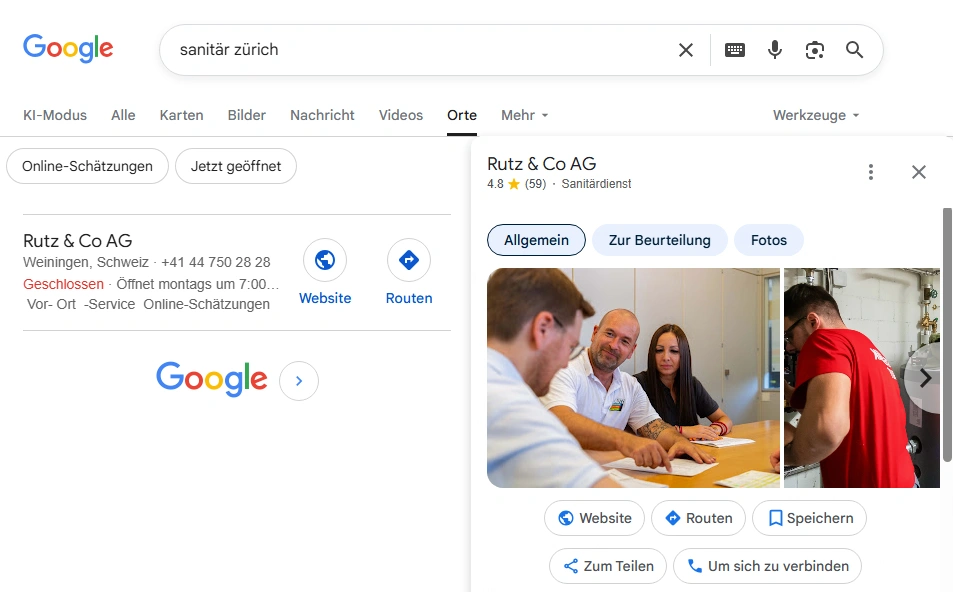
The local map package beats the organic list. In location-based inquiries, there are three additional factors beyond the traditional results. Those who do not appear there struggle to attract attention below. Completeness of the company profile, frequency of reviews, and consistency between category and performance aspects are crucial.
Agglomeration instead of city boundary. Your customers don’t just search “in Zurich”, but in Oerlikon, Altstetten, Dietikon, Wallisellen, Schlieren, Uster or Winterthur. We build the location structure along the actual catchment area, not along municipal boundaries.
Swiss usage. The search is conducted in Hochdeutsch, but the phrasing is in Swiss: Offer instead of offer, plumber instead of plumber, bike instead of bicycle, hospital instead of hospital. Anyone who takes texts from Germany misses the search requests of their own neighborhood.
Trust is a ranking factor in the Zurich market. Contact information, business registry entries, named contact persons, real photos, and verifiable references are not an afterthought here. They are what distinguish you from exchangeable brokerage portals — for people as well as for evaluation systems.
The operational implementation of the local part is described in detail on our page Local SEO in Zurich. If your area of operation extends beyond the canton, our second-ranked SEO support the appropriate framework.
The first 90 days: What happens in each week
Search engine optimization doesn’t work from day one, but it is verifiable from day one. This process applies to an average SME project in the Zurich area with an existing website. With a relaunch, weeks 5 to 8 are shifted back.
Week 1–2 Inventory
We measure first and then we talk.
Complete technical crawl of the domain, comparison with the Google index
Analysis of Search Console and Analytics over 12 months — including cleaning up for tool and AI mode queries (see data block above)
Keyword potential with click-through pricing experiment: Which demand is real?
Competitive analysis of the three strongest Zurich competitors
Result: written location determination with prioritized list of measures
Week 3–4 Technical clearance
First the brake is released, then the accelerator is applied.
Index cleanup: Noindex, canonicals, and redirect chains resolved
Resolution of existing cannibalizations based on the search term map
Core Web Vitals: Image formats, loading sequence, layout stability
Schema.org Essentials: Organization, LocalBusiness, People, Reviews
Internal linking: contextual links from the content text to the money pages
Typical first effect: Pages that were previously in positions 40 to 80 are now in the 15 to 30 range. No sales yet, but a measurable signal.
Weeks 5–8: Further development of content
Each side gets exactly one task.
Revision of existing money pages according to search intent
Building the missing pages from the search term card (performance, location, guide)
Editorial implementation according to our communication framework — with attribution of authorship so that expertise can be attributed
Question-answer blocks for visibility in the AI mode
Image and video material from our own production instead of stock photos
Week 9–12 Authority building
Only now is range outside the domain worthwhile.
Recording all unlinked brand mentions and subsequent linking
Specialized article or interview in a relevant industry or regional medium
Cleaning and completing local directory entries
Development of the Google Business Profile, including the evaluation process
Linking brand and person entities across all channels
Starting from month 4, follow-up visits
What works is amplified; what doesn’t work is removed.
Monthly reporting with the four key indicators from the table below
Analyses of content gaps against the currently ranked competitors
Expansion to secondary search terms and additional locations
Monitoring of Google updates and adjustment of the roadmap
Honestly: We typically see a measurable sales impact in competitive Zurich industries starting from month five to nine. Anyone who promises results within four weeks is either selling you a very simple keyword or an illusion.
How to tell if the optimization is working
Four metrics are sufficient. Everything else is a side effect or — in the case of impressions and click-through rates — now even misleading.
Indicator
What she says
Realistic development
Clicks on money-seeking terms
How many people who are ready to buy actually end up on your site. The only metric that directly correlates to sales.
First movement from month 3, significant increase from month 6
Position on money-seeking terms
Only the 10 to 20 search terms with a commercial intent, not the average across all queries. The jump from page 2 to positions 1 to 3 multiplies the clicks.
Position 20 → 10 in month 2–4, Position 10 → 3 in month 5–10
Volume of brand searches
How many people specifically search for your company name. Even so, when you are cited in the AI mode, you will not receive any clicks. This is the best early indicator for generative search.
Measurable starting from month 4, usually the first visible success
Qualified requests
Calls, forms, appointment bookings — separated by source. Without goal measurement, any SEO reporting is like reading a coffee list.
Measured from day 1, it becomes noticeable from month 4–6
What we consciously do No Use as success metrics: total impressions, average click-through rate across all inquiries, individual provider visibility indices, and the number of backlinks set. These values can be influenced without any customer calling in more.
How to recognize genuine search engine optimization
You don’t need to have any SEO expertise to assess an agency. Six questions are enough — and the answers say more than any presentation.
These are the six questions you should ask
What specific search terms are you targeting, and what is the actual volume of those terms in the Swiss market?
How do you measure success — and which metric comes first?
Who writes the lyrics, and is the authorship mentioned on the website?
How do you build backlinks, and where do they come from?
Who owns the access to Search Console, Analytics, and the Google Business Profile?
What happens to the rankings if we end the collaboration?
These five answers are warning signs
«We guarantee first place in Google.» Nobody can guarantee that. Google itself explicitly warns against such promises.
«We deliver 100 backlinks per month.» Quantity is not a quality characteristic; it is a risk factor.
«The access is done through our agent account.» Your data belong to you. We will set up all accounts in the customer's name.
«Minimum term of 24 months.» Those who deliver results do not need a long commitment.
«We show you monthly how much the visibility has increased» — without ever having to discuss inquiries.
You can find our own answers to these six questions throughout the entire website: the prices are openly displayed on the page. SEO Costs and Prices, The evidence in our Case studies, the authorship in the profile of David Bachetti.

Search engine optimization in practice
Four projects, four different starting points: a traditional business after ten years of digital stagnation, an international corporation with tens of thousands of sub-sites, a premium service provider without visibility, and a studio that became the local king within eight months. The method is the same in all four cases — the weighting of the three pillars is not the same.
What search engine optimization costs us
Same packages, same prices as everywhere on this website. Which package suits you depends on the competition in your industry, not on your company size.
You can find a detailed overview with market price ranges, billing models and a sample payback calculation on our page SEO costs in Switzerland.
Search engine optimization in synergy
Search engine optimization is the foundation. Depending on the starting point, additional disciplines are added. A complete overview of our services can be found here. SEO Agency Zurich You can find it on our home page.

The initial steps in any project: a written site assessment with a prioritized list of measures — also available as a stand-alone service.

Card package, company profile, location pages and reviews. For businesses with a physical catchment area, this is the most effective section.

Visibility in generative responses. The logical extension once the classic foundation is in place.
Tailored for businesses with a small team and a clear catchment area — with a correspondingly focused keyword scope.

If your market extends beyond the canton: multilingual strategies for German-speaking Switzerland, the Romandy region, and Ticino.

Paid search closes the gap while the organic visibility is being built — and in the process, it provides real demand data.
Questions about search engine optimization
What is the difference between search engine optimization and SEO?
There is no such thing. «SEO» is the abbreviation for the English term Search Engine Optimization and means exactly the same as search engine optimization. In Swiss usage, «SEO optimization» and «Google optimization» also denote the same performance. The only practical difference lies in the search behavior: Professionals search for «SEO», while female executives and managers often search for «search engine optimization».
What is the difference between on-page and off-page optimization?
OnPage encompasses everything that happens on your own website: technology, structure, text, internal links, structured data. OffPage encompasses everything outside of it: backlinks, mentions in media, directory entries, reviews, the Google Business Profile. A general rule for the Swiss SME market: In the first three months, the leverage lies at around 80 percent in the OnPage area; thereafter, it shifts increasingly to OffPage.
Can I do search engine optimization myself?
Partly yes, and we’ll be honest with you about which parts. A fully-maintained Google Business Profile, consistent contact information in the Swiss directories, an active review process, and regularly written, honest content about your own work will already bring a local business a noticeable advantage — without an agency. External support pays off where mistakes become costly: in technical interventions, in the keyword strategy in competitive markets, and in building authority. If we conclude in the initial conversation that you can handle most of the work yourself, we’ll tell you that.
How many search terms should I optimize?
Less than most offers promise. A local service provider in Zurich usually achieves over 80 percent of its organic revenue from 10 to 20 search terms. Anything beyond that is scattershot. We start with a maximum of 15 search terms that have a discernible intent to buy and a verifiable click price, and only expand once they are in the top 10.
Is search engine optimization still worthwhile when AI provides the answers?
Yes, but the measurement of success is changing. Generative response systems generate their responses from the same sources that rank conventionally — those that are not there are not cited. What is shifting is the click rate: your brand appears in the response without anyone visiting your website. That’s why we are also measuring brand search volume and citation frequency. In our own analysis, 160 of 1,000 search queries came from the AI mode — with an average position of 8.15 and zero clicks. This visibility is real; it just doesn’t appear in the click statistics.
How do I know if my previous optimization is working?
Don’t look at the total impressions in the Google Search Console; instead, filter on your five most important search terms and compare position and clicks over twelve months. If there’s no movement there while the total impressions are increasing, your optimization is working on the wrong search terms. Additionally, check if the number of organic search queries is measured separately — if this measurement is missing, you simply cannot assess the impact.
What happens to my rankings if we end the collaboration?
The technical basis, the content, and the built-in backlinks remain yours — they belong to your domain, not to us. In practice, the positions achieved in little-competitive niches hold for many months. In highly competitive Zurich industries, the decline begins after about three to six months, because the competition continues to work and Google prefers updated content. All access begins with your name. There is nothing you could lose by switching to us.
Location determination instead of a sales conversation.
We look at your website, assess the actual demand for your keywords, and tell you where the biggest leverage lies. If search engine optimization isn’t the most efficient means for your market situation, you can count on us — even if we don’t win a contract because of it.