


SEO Agency Switzerland: Visibility across all language regions.
One country, four languages, 26 cantons. One strategy.
Switzerland is not a small German market. It is a country with four national languages, its own directories, its own language usage and its own data protection law — on a territory where a business from Lucerne must be found simultaneously in Bern, Zug and Aarau. We build Swiss-wide visibility from Zurich: multilingual, with a clean site architecture and without the errors that arise when German templates are simply copied across the border.


As featured in


Six reasons why Swiss SEO follows its own rules
Search engine optimization in Switzerland differs fundamentally from the German or Austrian market in six points: by its multilingualism with separate search markets in German, French and Italian, by the use of language with its own specialized terms, by the role of the .ch domain as a national signal, by its own directories and evaluation platforms, by an independent data protection law, and by a price and purchasing power level that shifts the entire economic calculus.

1. Three search markets in one country
German, French and Italian are not translations of each other; they are separate demand markets with different volumes, different competition and different search logic. «Search engine optimization», «référencement naturel» and «posizionamento sui motori di ricerca» each require a separate keyword card.
2. Helvetism decides on the score
In Hochdeutsch is searched for, in Swiss is formulated: offer instead of offer, plumber instead of plumber, bike instead of bicycle, hospital instead of hospital, postal code in four digits, rappen instead of cent, «ss» instead of «ß». Those who take on German texts miss the actual search queries — and appear foreign to Swiss readers.
3. The .ch domain is a sign of trust
Technically, the country-specific orientation can also be controlled for .com domains. Practically speaking, Swiss users click on .ch addresses much more frequently for local services. For internationally oriented brands, a .com structure with clean hreflang is still often the better choice — the decision belongs at the beginning of the project, not in the middle.
4. Own directories and data sources
local.ch, search.ch, moneyhouse, Zefix, the industry associations and the cantonal business portals are the Swiss equivalents of what Yellow Pages and business registers do in Germany. They also feed Google data sources and are used as reference by language models. Conflicting entries are one of the most common and easiest to fix errors.
5. Own data protection law
The revised Data Protection Act (revDSG) has been in effect since September 2023 and is similar to the GDPR, but not identical. For tracking, consent banners, and data processing records, the rule is: Swiss websites need their own review. Faulty consent banners not only cost in legal terms; they also destroy the measurement basis of any SEO success measurement.
6. Other economic calculation
Swiss order values are significantly above the European average. A single additional bathroom renovation or a single B2B framework contract can justify an entire annual budget. Conversely, search volumes are lower — which is why the spread of broader search terms here yields less than elsewhere and the precision of the search term selection determines success.
We describe in detail on our page on the procedure itself — its technology, content, authority, and citation possibilities. Search engine optimization.

State-recognized expertise: Federal diploma & FH-certified


Who controls the language versions — and who writes them
Jurisdiction in multilingual mandates. Starts exactly where the page discussed whether the location of an agency matters.
In a nationwide mandate, several people work on the same domain. To ensure that one language version does not conflict with the other, it is clearly stipulated who decides what.
- Keyword map per language and overall control: David Bachetti, founder and SEO strategist, Swiss-educated web project manager (HFP) and ZHAW-CAS in Advanced Digital Marketing. He is also responsible for deciding on domain structure and language directories — the soft stuff that is put in at the beginning of a project and later is only too expensive to correct.
- Technical architecture and hreflang: Victor Bravim, our own developer. Mutual award, x-default and canonization is checked before each language launch, not after.
- Editorial in French and Italian: native-speaking expert authors from the Rhône-Alpes region and the Tessin region. We do not translate — we have new authors write for each language region.
- Legal framework: revDSG instead of the GDPR text component; billing in francs according to the Swiss standard.
The agency AGENTUR GmbH is a member of the Zurich Chamber of Commerce and has been a certified Google Partner since 2018. You can see this on our About Us page:, who is responsible for which discipline at our company; Degrees, specialist papers and the Career and professional publications of David Bachetti are also publicly viewable.


German Switzerland, Romandie, Ticino: three markets, three strategies
The most common and most expensive mistake in multilingual Swiss SEO is the assumption that a translation is sufficient. It is not. Anyone who translates French content from German automatically adopts the German search-word logic — and ranks poorly in the Romandie for terms that no one searches for there.

German Switzerland
Around two-thirds of the population, the largest search volume and the most intense competition — especially in the economic regions of Zurich, Basel, Bern, Lucerne, Zug, St. Gallen and Aargau.
Basic linguistic rule: Search requests in High German, texts in Swiss High German with Helvetisms and «ss».
Dialect hardly ever appears in search queries — with one exception: place names and neighborhood designations («Chreis Cheib», «Läbe im Seefeld») appear in local searches and reviews.
Regional directories and trade associations are the strongest local source of information here.

Romandie (Suisse romande)
Geneva, Lausanne, Neuenburg, Freiburg, Valais and Jura. Significantly lower SEO competition than in German-speaking Switzerland — which makes this market the most favorable growth reserve for national providers.
Customized keyword research is mandatory. French search terms are based on the French language, not on German equivalents.
Attention to numbers: In Romansh, «septante», «huitante» and «nonante» are commonly used — France uses other forms. When buying French texts from France, they sound imported in Lausanne.
hreflang must indicate fr-CH, not fr or fr-FR. Otherwise, you are competing unnecessarily with French providers.

Ticino and Italian-speaking Graubünden
The smallest but least competitive language market. For industries with Swiss customers or locations in Lugano, Bellinzona and Locarno, top positions can be achieved here with relatively little effort.
Low search volume — the evaluation therefore needs to be based on the order value, not the number of clicks.
Distinctive in its language to Italy: The Ticino dialect contains Helvetic elements that are absent in the Italian standard.
Practical example: For Randstad Switzerland, we have developed a multilingual tax document for the Ticino market to systematically reflect these deviations.

English as a fourth level
For companies with international clientele, expatriate target groups in Zug and Zürich, or export business, English is actually the fourth language variant — more frequently requested than Rätoromanisch and significantly more economically relevant.
Language version en-CH instead of en or en-GB if the offer is aimed at people in Switzerland.
Custom search terms: «seo agency zurich» and «seo agency zürich» are different queries with different competition.
Our own English language version is built exactly according to this principle.
Translating is not a keyword strategy
«We have taken on projects whose French versions were perfectly written and did not appear in Romandie anyway. The reason was never the quality of the translation, but the search term logic behind it: when you translate a German text, you translate the German search terms immediately — and then rank in Lausanne for formulations that no one there enters. A second language version is not a text assignment. It is a second project with its own search term map.»
— David Bachetti, founder and SEO strategist. Strategy and control are in the hands of to our team in Zurich, the editorial implementation by native-speaking professional authors from the respective language region.



hreflang: The point at which most Swiss projects fail
As soon as a website has more than one language version, the technical architecture determines whether the versions complement each other or cancel each other out. Faulty hreflang is the most common reason why a French language version simply doesn’t appear in the Romandy region — even though the content is good.
We see four mistakes in Swiss projects again and again:
Missing references. hreflang must be reciprocal. If the German page refers to the French page, but the French page does not return a link, Google completely ignores the link.
Language code without country. «The fact that »de« instead of »de-CH" puts your site in direct competition with Germany and Austria is a disadvantage that can be avoided for Swiss providers.
No x-default. Without the standard version, Google decides itself which language version is shown to users from unserved regions.
hreflang on redirected or non-canonical URLs. A reference to a URL that redirects via 301 makes the entire award ineffective.
In addition, there is the fundamental decision regarding the structure. We recommend sub-directories for almost all Swiss SMEs (/fr/, /it/Instead of subdomains or separate country domains: The authority remains concentrated in a single domain; the effort for technology and link building is not multiplied. Own country domains are only worthwhile for legally separate country companies with their own marketing — as we have implemented, for example, with a client with locations in Switzerland and Germany.
Do you need local or Swiss-wide SEO?
The answer does not depend on your company size, but on where your customers are looking for products and how far you deliver them. It is possible to do both at the same time, but it is more expensive than necessary if only one of these options fits your business model.
Local SEO is enough if…
- Your service depends on travel distance (trades, practices, restaurants, studios, law firms)
- more than 80 percent of your orders come from a radius of 30 kilometers
- Your card package entry is more important than your home page
- Your competition consists mainly of businesses from the same region
The perfect starting point is our Local SEO support or rather Search engine optimization for Zurich.
Nationwide SEO is worthwhile if…
- You ship, install or advise across cantonal borders
- You operate several locations or plan to open locations
- Your clientele is or will be French or Italian-speaking
- You work in B2B, where buyers research beyond their own region
- Your order value is high enough that individual invoices can cover the budget
Then this page is your starting point. The search term map is built for each language and region, not as a translation of a single template.
Several locations, without cannibalizing themselves
Location pages are the most powerful tool in worldwide SEO — and the most dangerous. Building twelve pages that differ only in the name of the locality creates exactly what Google has consistently devalued since the core updates of recent years. Four rules prevent this:
Each site page needs its own substance
Reference projects from the region, named contact persons, access route and catchment area, regional special features of the service. A given place name is not a separate page, but a risk.
Only locations with real presence
A location page for a place without a branch, without a reference, and without a contact person is quickly recognized in the Swiss market — by customers as well as by rating systems.
One company profile per location
Each location receives its own Google Business Profile with its own phone number, opening hours, and its own review process — and links to the corresponding location page, not the home page.
Clear hierarchy instead of a flat list
National performance pages act as hubs, with location pages acting as spokes; they are linked to each other. This way, you can consolidate authority on performance and distribute it purposefully to the regions.
Where in Switzerland are certain search terms being fought over?
The competitive pressure in Switzerland is very uneven. Those who are nationally oriented should invest first where the ratio of cost to order value is most favorable — and that rarely is Zurich.
Zurich and the Limmattal region
Switzerland has the highest level of competition. Local businesses compete with national comparison portals as well. Here, authority matters, not the amount of content.
Bern and Mittelland
Moderate competition, a strong role for regional media and associations as a source of links. Industries close to the administration with above-average potential.
Basel and the North-West Switzerland
Life sciences, chemicals, logistics. A notably high share of English-language search queries in the B2B sector.
Central Switzerland (Lucerne, Zug, Schwyz)
Very high purchasing power, comparatively low SEO competition. One of the most attractive regions in Switzerland for construction, home automation and consulting.
Eastern Switzerland (St. Gallen, Thurgau, Appenzell)
Industry and commerce, a less saturated market, a strong impact of local association work.
Aargau and Solothurn
A commuter region with high demand for services, but comparatively weak digital capabilities among providers.
Winterthur and the Upper Zurich Region
an independent search market next to Zurich, see our page SEO in Winterthur.
Geneva, Vaud and Wallis
French-speaking, significantly lower SEO competition. The largest untapped reserve for national-based providers.
Tessin
Italian-speaking, smallest volume, lowest competition. Pays off at a high order value.
Nationwide mandates from practice
National visibility cannot be claimed in a presentation; it is manifested in projects involving multiple languages, multiple locations, or multiple countries. Four examples from our ongoing work:
Personnel services, national
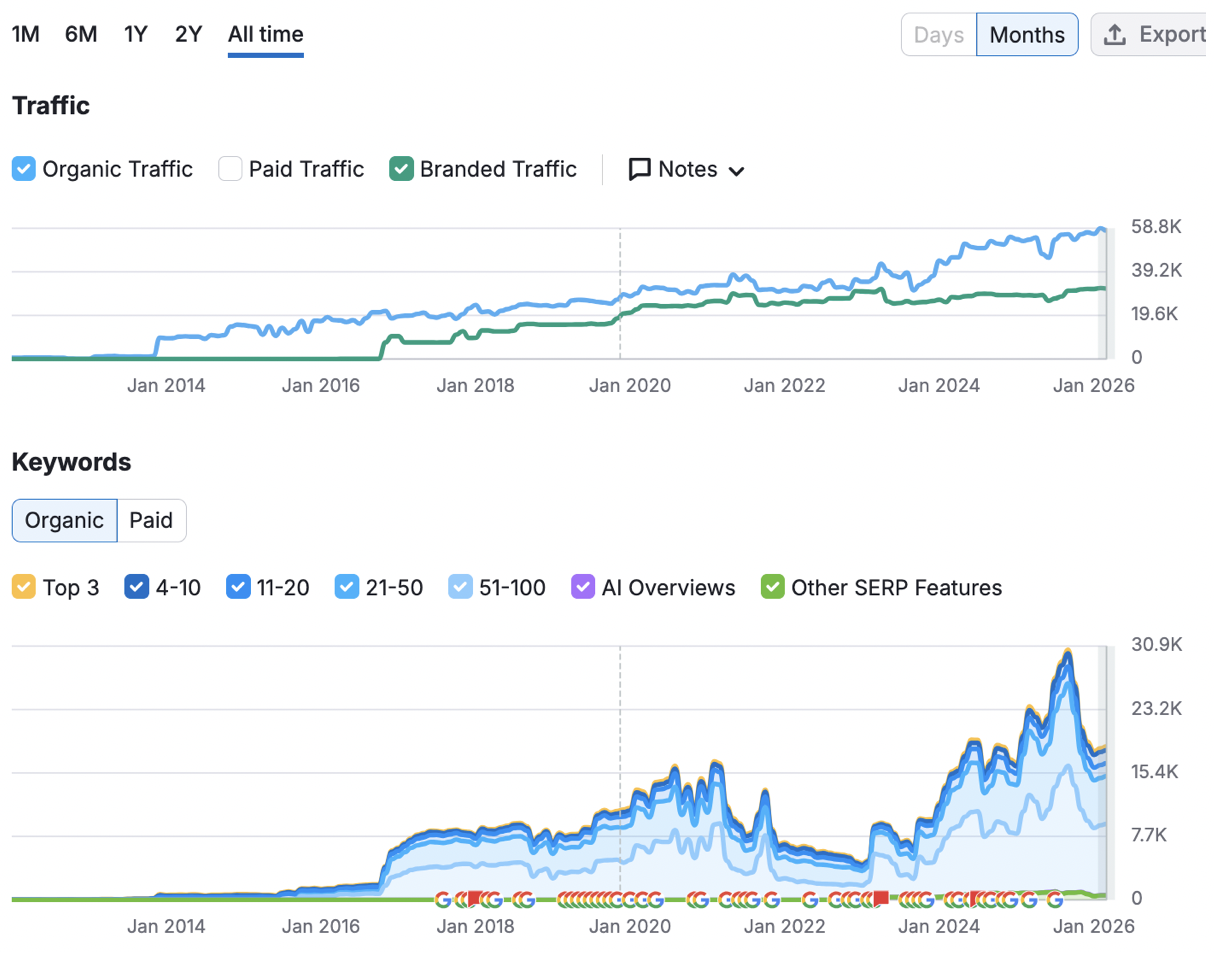
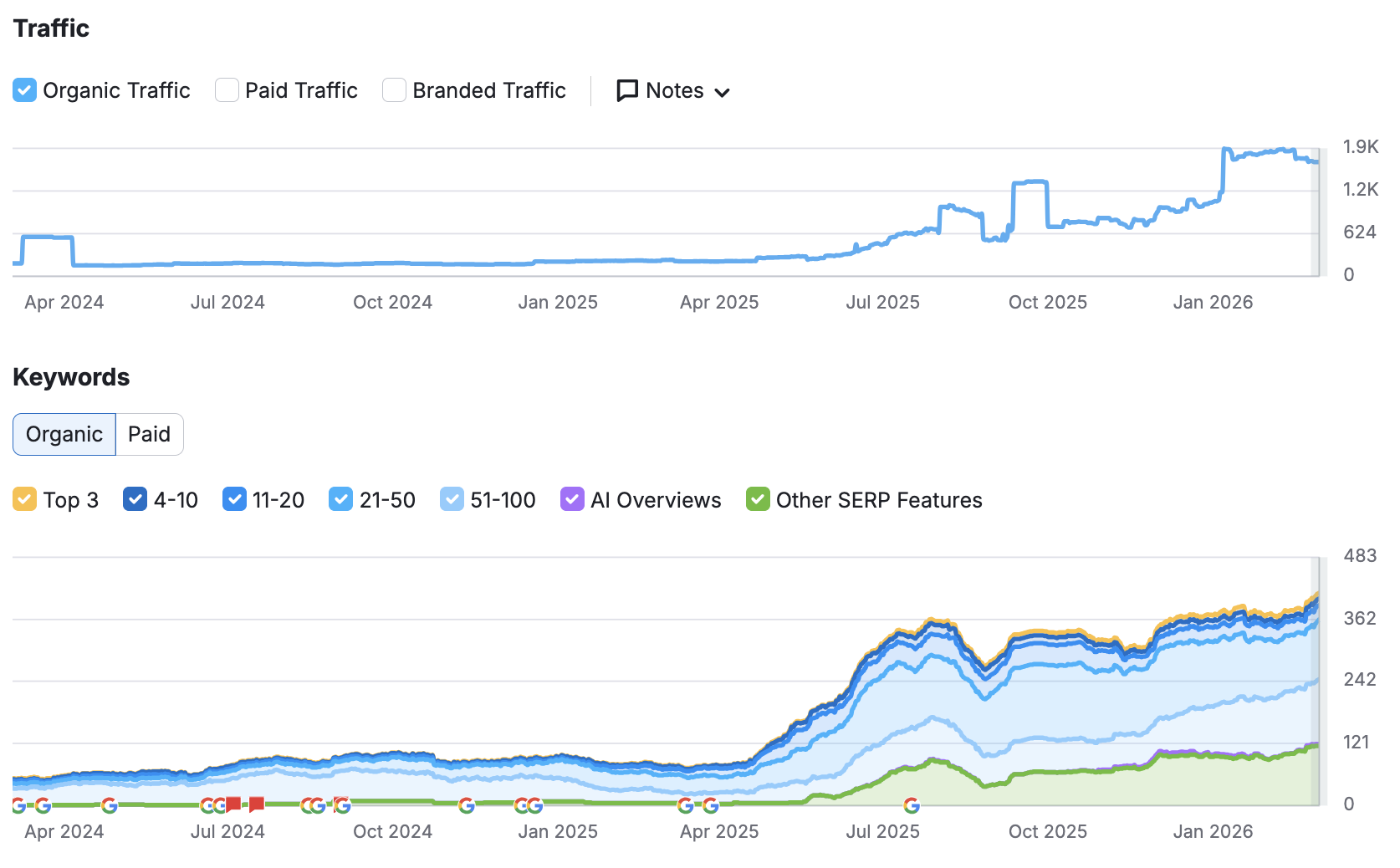
For Randstad (Switzerland) AG We have unraveled an enterprise architecture with tens of thousands of sub-sites, solved technical roadblocks, and built the content strategy for the medical specialties — including a multilingual tax document for the Swiss market. The result: over 220 percent organic growth in twelve months.
Industry, internationally
For the Connova Group With locations in Villmergen (CH) and Klipphausen (DE), we manage a multilingual domain structure, including hreflang implementation before the French language launch, specialist publications in industry media, and international lead generation in the defense and UAV segments.
B2B promotion technology, nationwide
For the IBAG Fördertechnik AG We are building visibility for Swiss food and pharmaceutical manufacturers — with expert articles in industry media and performance pages along the actual product categories, rather than along the company structure.
Water treatment, Switzerland-wide
For the Free AquaService AG We connect regional case studies, specialist publications on regulatory issues, and performance pages for a market that stretches from Geneva to St. Gallen.
The fully documented cases with figures can be found in our Case studies.
Does it have to be a Swiss agency?
No — not necessarily. But there are four points where the location in Switzerland makes a factual difference, and three where it doesn’t matter. We include both because you are supposed to make a decision and don’t need a sales message.
Where location counts
- Language and market knowledge. Helvetism, regional search logic, and knowledge of the Swiss directory landscape cannot be inferred from tool data.
- Legal framework. The revDSG, Swiss competition law and sector-specific advertising regulations (e.g. in the healthcare sector) differ from EU law.
- Billing. CHF, Swiss VAT, invoicing according to Swiss standards — without currency risk and reverse-charge charges.
- Network. Professional media, associations and chambers are business relationships. A contribution in a Swiss professional media outlet is generated through contacts, not through an open call for tenders.
Where the location doesn't matter
- Technical work. Crawls, Core Web Vitals, and structured data are language-neutral. Our own developer works remotely — quality depends on the person, not the location.
- English-language projects. Those who sell internationally need international search-word understanding, not a Swiss local context.
- Pure analytical work. An audit can be conducted from anywhere — what matters is whether it leads to actionable steps.
Our own team: Based and rooted in the canton of Zurich, a member of the Zurich Chamber of Commerce, an official Google Partner — with a team trained at Swiss universities and with international experience. Learn more about the people behind us on our page. About us and in the profile of David Bachetti.
Documented results
From the Zurich-based traditional company to an internationally established groupThese four case studies are fully documented with figures, timeframes, and screenshots.
What does Swiss SEO cost?
For national and multilingual projects, the Professional or Scale packages are usually the right foundation — the effort scales with the number of languages and locations, not with the size of the company.
You can find market price ranges, billing models and a sample payback calculation on our page SEO costs in Switzerland.
Questions about Swiss-wide SEO
Do you also work in Romandie and in Ticino?
Yes. Strategy, keyword mapping, technology, and control are all based in Zurich; the editorial implementation is handled by native-speaking subject matter experts from the respective language region. We do not translate German texts; instead, for each language we create a dedicated keyword map — otherwise, you would have to search for terms in Lausanne that no one else is searching for.
Do I need a separate website for each language region?
In most cases, no. We recommend language versions as subdirectories on a domain (/fr/, /it/, /en/). The authority remains centralized; the technology and link building only need to be done once. Separate domains only make sense for legally independent national companies with their own marketing budget and brand.
Should I use a .ch or a .com domain?
If your customers are predominantly based in Switzerland: .ch. The domain extension acts as a sign of trust and country recognition and increases the click-through rate in Swiss search results measurably. If you want to export or scale internationally: .com with clean hreflang and a /ch/-structure. The most important thing is to make the decision early — a later domain change regularly costs several months of visibility.
What is hreflang and why is it particularly critical in Switzerland?
Hreflang is a technical designation that tells search engines which language version is intended for which target audience. In a monolingual country, it is optional. In Switzerland, it is mandatory because here three language versions of the same website compete for the same geographic region. Without proper hreflang, Google decides for itself which version is displayed — and it regularly gets it wrong.
How long does Swiss-wide SEO take compared to local SEO?
Significantly longer, because the competition is larger and the local card package is not available as a shortcut. Rule of thumb from our projects: Local visibility in the card package is noticeable after three to six months under a clean starting position. National positions on battle-hardened search terms usually take nine to eighteen months. However, intermediate successes on more specific search terms and in the Romandie occur significantly earlier.
Can an agency from Germany provide Swiss SEO services?
Technically yes, linguistically and regulatory terms with limitations. The most common friction points in the projects we have taken on: German terms in Swiss texts, «ß» instead of «ss», missing de-CH in hreflang, unknown Swiss directories and GDPR data protection notices without a revDSG reference. None of these points are unsolvable — but they do cost time that you cannot afford to waste if you don’t know them.
Do you also provide services to companies outside the canton of Zurich?
Yes, a significant share of our mandates is outside the canton, including in Lucerne, Aargau, Solothurn, Zug and Germany. We work together via video conference, a shared real-time dashboard and fixed strategy meetings. For managing an SEO project, physical proximity matters far less than a clean rhythm. The same applies to Google Ads campaigns, for example for Google Ads in Lucerne or Google Ads in Zug.
Where is your largest unused region located?
We examine which language regions and economic sectors you are currently visible in, where the demand actually lies, and in what order you can best improve your situation. In writing, with numbers, without pressure to sell.